Showing posts with label Politics. Show all posts

04 August 2011

Raise High the Debt Ceiling, Carpenters

It pains me not in the slightest to open up this little discussion by entirely neglecting the point. I wish in the first place to apologize for its title. I suppose the apology should be squared directly at two people, really. First, J. D. Salinger himself. Mr. Salinger, I trust you will forgive the profaning of one of your perfectly good stories, as well as my voice, which, the more I write, seems more lifted from them all (although it really is a matter of debate whether I first heard myself through your writing, or if the writing taught me how to be heard). Courtesies aside, you are in fact dead, and if you were not, would certainly consider the benefits of being so if you found out anyone was blogging a word about you. Second, Mr. J. D. Weichhand. Josh, I'm going to be honest: I just really want you to read everything I write and give me your approval. You are the Seymour to my Buddy Glass. Having said that, I'm thinking about it more and it's remarkable how true that is in so many ways. Just don't kill yourself.


There is no political subject matter which consistently enthuses me less than finance. I think part of this is related to the fact that most financial issues deemed political, to me, should be more accurately classified as moral questions. Case-in-point perhaps being the classic: Is it okay for some hard-working people to be outrageously rich while others who work just as hard are in poverty? Does anyone have the right to tell the rich they are too rich? If this is a simple political question, then one's answer places him or her somewhere on a scale between Bleeding Socialist and Heartless Capitalist Banker. St. Paul perhaps urges us to expand the conversation. 

The other reason it is so hard to care about the debt ceiling, inflation, or the stock market is because the whole thing is so artificial to me. Wall Street invents money out of thin air by betting on a company's failure, literally getting paid for doing nothing. Meanwhile, the government is fighting a multi-trillion dollar war, and all that's needed for both absurdities to continue is the printing of more money. So why shouldn't the economic elite who know the game be able to amass personal fortunes like a slight-of-hand magician with an ace up his sleeve, when our entire monetary system is just as deceptive and slanted?

Let us also remember that this entire 'debate' is an ideological sideshow. The government spending in question has already been approved by the same phonies standing up on the Hill telling the other side to cut back. Having this debate now only determines whether or not the country will pay those bills. The only purpose of this whole charade of the Right's is to rub the bellies of their tea party supporters. Regarding these, a few words may be appropriate. In its current embodiment, the tea party movement is the worst thing to happen to American politics in my lifetime. It's not that I disagree with every single thing they stand for (which I do). It's not that people who tote guns, dislike foreigners, and hate the idea of everyone being able to go to the doctor scare me (which they do). It's not even that many of them lap up every word of a bona fide crazy person like Glenn Beck (which they do). (Dear reader, this is all starting to sound mean-spirited, but please remember that it's not mean if it's true.) (I apologize for the recent mean-spirited parenthetical disclaimer.)

What frightens me about the tea party is that they have successfully taken the entire Republican party by the throat. Any of us who follow Conservative politics for five minutes will know that the current modus operandi is: Raise taxes, you're gone. Spend money on any program but warfare, you're gone. I think to some extent all these Republicans are trying to do here is keep their jobs. What the tea party has created is a political system entirely contrary to what their dear founding fathers intended; a political system in which compromise is out of the question and one is tricked into believing that every choice is a choice between two ideological extremes. Remember when Mitch McConnell proposed a perfectly sane compromise deal at the beginning of this whole debacle? The man was practically crucified in the conservative media. Trying to see where the other side is coming from, give-and-take are tantamount to treason. A few weeks ago Glenn Beck flat out said that what our nation is facing is a choice between fascist Communism and Libertarian freedom. In other words, there is no middle ground. Wouldn't you rather be a tea-partier than a Communist??

I remember a while back, after the recent health-care bill passed (typically referred to as 'Obamacare'), I was really disappointed in Dennis Kucinich for voting for it. Kucinich is a man I have a deep respect for and one of the only people in Washington I trust. How could he sell out like this? He promised to fight for single-payer, but now has voted for a bill that effectively hands over thousands of new customers to the insurance companies! I was impressed when he sent out a letter to his supporters explaining his vote. The short of it comes down to the fact that he saw a 'yes' vote on that less-than-stellar bill as at least a tiny baby step away from the current system. After speaking with the president at length the day before the vote, he realized that a 'no' vote would be much more damaging in that it would halt the debate altogether and no one knew at that point how long it would be before they would have the majority votes necessary to pass any kind of reform again. So he compromised. He looked at the bigger picture and said, "This is too important to take an ideological stand and cast a meaningless vote." As I look back, I don't think Dennis sold out at all. His ideological stand was the countless hours he spent educating people on socialized care, working the House floor, and never arguing for anything less than what he knew to be the best thing for America.

This is exactly where the Republicans are a complete and utter failure right now. The American people aren't hearing arguments for why tea party policies are the best thing for the country. We are simply being scared into believing that the country is on the verge of apocalypse unless the tea party has its way (and I say that with complete seriousness). We are being told that compromise is out of the question because one side and one side alone has access to the divine revelation of what the United States is and how to save it. No deviation from the straight and narrow can be afforded.

If we all walk away from this glorified Lebron-announcement with anything, it should be a recognition that the only way we are going to stop our country from walking down an extremely scary path is to refuse the hand we are dealt.

30 August 2010

Cultural Isolationism: The American Right and NYC


In case you haven't had the chance to talk to a conservative lately: THE MUSLIMS ARE TRYING TO BUILD A MOSQUE IN NEW YORK CITY ON GROUND ZERO AND ANY PATRIOTIC, CAPITALISM-LOVING AMERICAN SHOULD BE UTTERLY OFFENDED!!

When I first heard about the proposed plans to build a mosque near the former World Trade Center site, my initial response was pretty mild; I really didn't care. Then, to my surprise, several weeks later I realized we were in the midst of a media explosion concerning what had apparently become a supremely important, hot-button issue. Shortly thereafter I could not believe the extent to which people were losing their minds over the whole thing.

I have no interest in recapping (as I'm sure you have no interest in re-reading) this whole debacle from start to finish. I would, however, like to simply stake up a few points and present my interpretation of one side of these events, considering I have very limited knowledge of what is actually taking place 'on the ground,' as it were. 

Cultural Isolationism: The American Right

I have to say the irony here is hilarious to me. For the last 2 years, the Right has tirelessly undergone a flash makeover from the aggressive neo-conservatism of George W. Bush and John McCain to a nostalgic, half-baked constitutionalism led by media stars such as Glenn Beck and Sarah Palin rather than traditional politicians. So, I suppose it's no surprise that the precious Constitution of the United States--tearfully clung to when fighting taxes and gun laws--has so suddenly been put in check by questions of prudence and (imagine!) contingency.

That being said, it seems clear that with the November elections rapidly approaching, the party of Rush Limbaugh and Newt Gingrich have thrown their ideals out the window in order to concoct a very powerful wedge issue. The republic as we know it cannot function efficiently when people try to understand one another and find some unum in their pluribus. When we are on the eve of an election, it is essential for citizens to be pushed as far to one side or another in order to ensure a decisive victory.

The goal here, as per usual for the GOP since 9/12/01, is to exploit the emotional memories of September 11 to conjure up an Us vs. Them situation which I'm calling Cultural Isolationism. In the same way economic isolationism seeks to protect domestic product and labor by shutting out all outside influence, I see recent trends in conservative politics trying to protect American culture--and I should stress that this is an idealized, fabricated notion of the true founding-fathers-judeo-christian-American culture--and 'American values' by seeking to divide and isolate.

We must be extremely mindful of what is going on here, and what the results will be if we allow a very select few to determine what American culture--or perhaps more accurately, American demographics--should look like. For the American right, it's clear this Islamic center issue is not a Constitutional one. Nor is it even an issue of respect for the dead. This has everything to do with fear and power. Fear of the outside, fear of appearing weak, and power to melt the great American experiment down to a neatly defined, isolated conservative reduction.

There is really no debate, as far as I can tell, over whether anyone has the right to build a place of worship; of course they do. Furthermore, we all know it's wrong to forbid someone from building a place of worship just because they are of the same religion as a random group of terrorists. Let's instead think about who is benefiting from this even being a debate, and whose lives go by the wayside while it happens.

12 June 2010

On Single Party Rule or Democracy

Last week on Hardball, Chris Matthews brought up what I thought were some pretty poignant observations regarding the current political landscape in the United States:


I think this analysis is simple and spot-on, and it struck a chord with me by bringing to the fore an underlying ethos that seems to be so prevalent in ever-evolving conservative circles such as the tea party movement (and this is not to say it is not also present in much of the Democrat Party) which states, "We alone have access to the truth on how to run the country; if you're not one of us, you're out." I've always found the tea parties to be wholly uninspiring and relatively confusing; the only unifying thread as far as a political philosophy is CUT TAXES--or, if we're being generous we might be able to add KEEP THE MEXICANS OUT to the platform. Yes, people are entitled to their ideology, but why is this problematic politically?

Matthews here is pointing towards a key aspect of democratic societies that is being neglected in increasingly troubling ways both in the United States and Europe. Democracy by definition is pluralistic. I strongly believe that despite the way we typically think of democratic processes (particularly voting) as majority rule, democracy must include empowering and allowing a voice for the minority (or more accurately, minorities; and by this, I mean any person[s] either not represented by the majority, or neglected by its policies). As evidenced by the latest parliamentary election in the Netherlands, this idea can be rapidly forgotten amidst fear and xenophobia in the face of cultural change.

If we are to retain the idea of democracy any longer, we ought never adopt platforms which seek to homogenize or exclude. Rather, we should be vigilantly generous and hospitable; inviting the Other in, and seeking out any voice which is not being heard.

04 March 2010

Okay, Glenn Beck (Rights, the Constitution, and Soviet Aesthetics)


From time to time I purposely subject myself to things like Glenn Beck's television show. Call it a kind of monastic self-flagellation. I try to be well-rounded in my consumption of political commentary, and I really do believe that we all benefit from hearing things from a different perspective. On one particular occasion, however, after watching a mere 13 minutes of his program, my head hurt so much that I couldn't even laugh at the absurdity of what was being spewed.

I love a good discussion, and I love hearing opinions that are not mine. But, dear Glenn Beck, please, for my sake, ensure that your opinions at least make sense.I've taken the liberty of transcribing the best part to give you an accurate representation of what was actually said without leaving anything out and without paraphrasing, but if you can stomach it, you can watch the full, weird, pathetic, woeful lamentation here (and i don't hesitate to use those words, because sounding pathetic and woeful is clearly Beck's shtick). Beck began his program by using an old wooden chair to represent the quote-unquote true America as it was in its 'original state.' Then came:
There were rallies today in California and all around the country (facing video of protesters lining the streets with placards). They were promoted as--look at these pinheads--they were promoted as 'saving education.' Well who--who doesn't want to save education? But the education budget wasn't the real goal. Let me show you a little something about the people involved in these protests. These were the posters that were used to promote this (walking toward a large poster featuring a slogan, and a logo of a fist on a book, painted in red, black, and white hues). Right here: 'Education is a human right.' Really? Wow. Education is a human right--boy this--almost looks like old, Soviet propaganda art dud'n'it? These people feel so strongly about education, you think they'd be educated to know that education is not a right. The Constitution doesn't mention that one. Let me clarify that; the United Sates Constitution doesn't mention that; this one does (holding a red document inscribed with Russian writing). This one. This is the Soviet constitution. Oh, it mentions education; free education for everybody, mhm. Let me help. Save the education. Rights do not come from government, they never have. If they do, you end up with a completely different government. You end up with a footstool or you end up with, what are those things that--stockades. Your rights come from God. If government grants you rights then you're a slave to the government, because if they grant them, they can also take them away. In America you don't have that right. This is what knowing what this chair is all about is all about. You gotta know what it is. Adding in education is just adding another coat of ugly paint; another ding, another scratch, somebody else just standing on it or, whatever. It wasn't designed to do that. If you want government to start granting rights then perhaps it's time to start looking for something other than a chair. Something entirely different than this because that's not what this one does. That's what this one does (raising the Soviet constitution).
First, I just want to lay out one of Beck's lines of persuasion: If the the cause is protected by the Soviet constitution (and the art looks Soviet!), then the cause is fought for by communists. Therefore, I'd like to point out to Glenn that article 53 of the Soviet constitution defines marriage as being between one man and one woman. Right now, Mr. Beck, there are people--people protesting to have an identical article added to our sacred constitution. Here--in the God-blessed U.S. of A.! Please, Glenn--reveal this conspiracy to the world. Stop these pinheads from passing these--they call them 'protection of marriage' acts--but we know what the real goal is.

Second, I think Beck is very confused in regards what he actually thinks about the nature of rights. Granted, his job is to say things, not to think about them, so we must offer him a measure of grace. Let's try to help him out, though, by pointing out a few conflicting little nuggets:
  • "...education is not a right. The Constitution doesn't mention that one." Again, let's lay out this logic: The U.S. Constitution does not cite education as being a right. Therefore, education is not a right. We can also infer based on this argumentation that the Constitution is exhaustive in its delineation of rights, since we should not be adding more. Furthermore, we have assurance that by way of granting us the rights it does mention, the document also assures them to us against forces which might seek to take them away. Fair enough.
  • "If government grants you rights then you're a slave to the government, because if they grant them, they can also take them away." Wait, Glenn, so are you saying that you and I and all U.S. citizens are enslaved by the Constitution rather than liberated by it?
  • "Rights do not come from government, they never have." Oh, okay good, you had me scared for a second there. But you're still appealing to the Constitution to hold your whole argument together. So, if the rights granted in the Constitution are not granted by the government, then who grants them?
  • "Your rights come from God." Alright, I'm following. Our rights come from God, and the Constitution is an explanation of those rights. Now, just so i can pass this knowledge on to unbelievers, can you point out to me the Scriptures the founding fathers used when they were putting this list of rights together? Maybe just the ones talking about the right to form a well-regulated militia, protection from quartering of troops, protection from unreasonable search and seizure, oh and right to counsel, I better memorize that verse, prohibition of excessive bail, and lastly, since states' rights is a big issue right now, where in the Bible should I look to show people that powers not delegated to the United States are reserved to the states or the people? ...what do you mean there's nothing in the Bible about that? Okay, I get it, so the United States Constitution is an extra-Biblical revelation the founding fathers of the nation were divinely inspired to write down. Got it.
The talented Mr. Beck has apparently acquired the unique ability to believe three distinctly different things about the nature of rights at the same time! Rights are granted by the Constitution and rights have never come from government (in fact, "If you want government to start granting rights then perhaps it's time to start looking for something other than a chair") and political rights come from God!

Well, I do think Glenn is right about one thing. If your entire conception of the rights we now or ever could have is based on the U.S. Constitution (the version we have in 2010), then you truly are a slave to it. And I must stress here, on a philosophical basis, that more accurately, you are a slave to your conception of and interpretation of that piece of paper. In Beck's case, one can conveniently forget about something like the 9th amendment (my personal favorite):
The enumeration in the Constitution, of certain rights, shall not be construed to deny or disparage others retained by the people.
So here, I will try, on behalf of our good friend Glenn Beck to clear up some of his confusion:
  • There are indeed certain fundamental things we know about humans, by nature of their being created in the image of God, which entitle them to certain rights.
  • However, the rights themselves are not granted by God. It is people themselves who have the responsibility of recognizing these truths and seeking to allow various rights and responsibilities universally to others.
  • In the case of the United States Constitution, our founding fathers wrote down an interpretation of--not an explanation of--the 'inalienable rights' they observed; they labored within their own personal/historical/social contexts to provide the nation with a basic understanding of these. So, for them it made sense that the right to vote applied only to white, land-owning males. However, over time, our interpretation of that same right has evolved.
  • In addition to the evolution of recognized rights, our common collection of basic human rights, and our conceptions of them, is equally dynamic. Obviously, part of this is due to shifting collective political mindsets. However, I think the bigger reason is that the nature of our shared experiences is constantly changing. For example, not only have we chosen over time to collectively reject the idea of slavery itself, the picture we get of 21st century slavery is vastly different than the picture of 18th century slavery; the specific human rights relating to this issue often deal with things like forced sexual relations with children, as opposed to, say, racial domination.
  • If the communal landscape is such that people choose to deem education a right, then by way of the liberties supposedly entitled to them by prior rights agreements within given communities (such as the Constitution), the people may choose to paint their chair whatever color they please. (Or create and adopt new agreements; see The Universal Declaration of Human Rights, drafted in 1948, believe it or not. See specifically article 26.)
As far as I can see, aside from blatant errors in argumentation, Beck's fundamental error is that of making the issue of Rights an ontological question, rather than a hermeneutic one (for that matter, I think he's forgotten that rights, in practice, are a political question!). So, it's no wonder all he has to grasp onto to hold his position together are bizarre conspiracies, fear tactics, and nostalgia. Though, I'm not sure if nostalgia is the right word for pining after bygone things that were never there in the first place; I think that might be more related to dementia.

10 February 2010

Viggo on Dennis

Obama's best material during the campaign was cherry-picked from the things Kucinich had been talking about for a long time. And Kucinich continues to be really the people's congressman. He is the one with the most conscience regarding health care, the banking issue, the bailout. He's the guy who said we should not go into Iraq, and was called a traitor for it. He was a guy who said, "This Patriot Act is not a good thing, we should not vote for it." Even people in his own party were saying, "Why do you say that?" And he says, "Because I read it," and there was silence. 'Cause none of them had read it. They just voted yes because they were told to. Same with health care stuff.
Viggo Mortensen: actor, poet, painter, publisher, photographer, smart dude. You can check out the full interview over at Mother Jones.

11 November 2009

Terrorism: Act or Label?

Several weeks ago, you may may remember hearing about the Boston man who was arrested for plotting an attack on a shopping mall as an act of jihad. What struck me about the coverage of this story was the constant use of this word terrorism and its other forms.

I immediately recalled the horrific events that transpired in an Amish school house several years ago.

I remembered when news broke of a brazen shooting in the Holocaust museum in Washington, D.C. and how I wondered what can cause a man to hate like that.

I also flashed back to my sophomore year of college, sitting in the lounge at school, watching as the surreal Virginia Tech shooting unfolded. The Virginia Tech attack particularly affected us as students, hearing about the massacre of 33 people just like us.

Then, news of the execution of John Allen Muhummad today brought back memories of the D.C. sniper shootings and the way a whole portion of the nation was stricken with absolute fear.

The list goes on, and I couldn't help but notice that I never remember hearing "terrorist" or "terrorism" in connection with these events or those who perpetrated them. I wonder, is there some sort of rule of thumb that determines whether vicious attacks like these are either terrorism or just your typical, plain, old, run-of-the-mill mass-murder?

Certainly we can't say that it is the number of victims which crosses the line into terrorism territory; the Virginia Tech shooter killed 33 people in a matter of hours, but wasn't deemed a terrorist.

Nor are we led to believe that targeting a specific group of people for being who they are, because of some sort of agenda, grievance, or twisted logic makes one a terrorist; the anti-Semite in D.C. had every intention of killing Jews, and the man in PA specifically targeted Amish girls.

So, I couldn't help but wonder whether the term "terrorist" only applies to Muslims. I have to say that this largely seems to be the case in post-9/11 United States.

However, I recall that the D.C. sniper professed to being a Muslim, and even talked about jihad in his writings. Being a militant Muslim did not make him a terrorist. And for that matter, neither did brainwashing his teenage accomplice. Perhaps most astonishingly, even INCITING TERROR on a massive scale did not qualify John Allen Muhammad.

Where is the disconnect?

This question was suddenly thrust into the spotlight after the tragic news of the shooting at Fort Hood came out last week. Fox News even put up this poll asking whether the massacre was an "act of terror or a horrific crime".

There is so much wrong with this picture! Not only do we not have a clear picture of what even constitutes terrorism--which, by the way, we are apparently fighting a War against--but what benefit does this distinction even offer us?

I therefore have three questions:
  1. If (and this is a majorly huge, theoretical if) one concedes that it is possible to defeat terrorism through the use of War, how can said War be won if its target has no clear definiton? Would not the extent of such a War become as indefinite as its target?
  2. If the moniker of "terrorist" does not coincide with a specific act, type of act, or motivation, is not the label then a purely political one?
  3. Are not all "acts of terror" and "horrific crimes" one in the same?
A victim of an act of terror in Jerusalem. A victim of a horrific crime at Virginia Tech.

14 August 2009

War According to the Artful Dodger

After getting sidetracked for a while, I recently resumed reading Oliver Twist. One passage in particular stood out to me as I read it several nights ago, and I thought it would be worth sharing.

To set this up, the pure and innocent character of Oliver is in the midst of being indoctrinated into a band of young pickpockets headed by the cunning and self-interested Fagin. One of Fagin's most gifted boys, the artful Dodger, is attempting to help Oliver overcome his intrinsic moral objections to adopting a criminal lifestyle:
'If you don't take pocket-handkechers and watches,' said the Dodger, reducing the conversation to the level of Oliver's capacity, 'some other cove will; so that the coves that lose 'em will be all the worse, and you'll be all the worse too, and nobody half a ha'p'orth the better, except the chaps wot gets them--and you've just as good a right to them as they have.'
Fagin commends this explanation and directs the impressionable Oliver to take the Dodger's word for it; he being a boy who "understands the catechism of his trade."

Within the larger context of the book, I think what Dickens wants us to be aware of are the underhanded, often imperceptible ways in which society is taught to accept and even perpetuate various forms of violent exploitation (particularly in this book, systematized, class-based poverty). Taking this a step further (and I'm sure this will roll a few eyeballs belonging to some of you who think I sound like a broken record) I couldn't help but think while reading this how similar the Dodger's enticement is to many contemporary justifications for war.

What the Dodger has successfully done is create an argument which appeals to both the altruistic and the selfish aspects of human nature. People are going to get robbed; that is a fact of life. If indeed people must be robbed, wouldn't they be better off in the end if a good person like you did the robbing? There's no telling what a very bad person might do to the poor soul in the process of robbing them. Furthermore, not only will the person getting robbed be better off if you do the robbing, but you will better your own situation in the process. Everyone wins!

It is worth adding here that in a later conversation with Bill Sykes, Fagin reveals that he sees great promise in the future criminal career of Oliver (a career which will almost strictly profit Fagin himself). However, the key would be to entice the boy to commit his first robbery; then and only then would Oliver fall securely into Fagin's pocket. There he could develop into the next Bill Sykes (but conveniently less strong-willed), who, in addition to burglary, would not shy away from taking a person's life if he saw fit.

I admonish the reader to seek a deeper sensitivity to the sly way in which our societies are sold a proverbial bill of goods relating to matters of war. What the Dodger does not disclose to Oliver is that one's perceived righteousness in carrying out an immoral act does not make the action any less evil. This I believe includes supposed "necessary" evils, as well as those which seem "natural" or inherent to our present reality as robbery in this case was made out to be.

I also found it interesting that Fagin refers to the Dodger's explanation as being an illustration of the "catechism" of the criminal trade; the term catechism being typically used in a religious sense to describe an outline of the beliefs within a given faith. This is another aspect of the way we think about war which I think we need to be keenly aware of. In accepting the rationale for--thus necessarily, acts of and loss of innocent life resulting from--war and warfare, we are not simply making a one-time decision or casting our vote for a single issue; we are choosing to adopt an entire system of belief.

We must also seek an awareness of the principalities (to use the old Biblical term) into whose control we place ourselves when we affirm the tenets of such a "catechism." In many cases, one well-intentioned act can have far-reaching repercussions which place control of our lives (as well as the lives of countless others) in the hands of very dark forces that seek only to desensitize us and further justify increasingly abominable acts.

02 August 2009

Questions About Consitutionalism


Over the last several years, I have noticed a pointed rise in the popularity of Constitutionalism. To be fair, I want to note the necessary distinction between what I've seen to be two distinct brands of the movement: The first is Constitutionalism as a comprehensive political stance. I see this platform as being traditionally positive in that its impetus is an affirmation of what they interpret to be a strict adherence to the verbage of the constitution. This is in contrast to the second brand which resides within certain conservative Sean-Hannity-like circles who nominally describe themselves as Constitutionalists when it is politically advantageous to do so (generally during important Supreme Court goings-on such as the Sotomayor hearings), while conversely discarding it altogether when they see fit (generally during times of widespread panic, where it can easily be defended as an action which will protect the nation, for example in support of the Patriot Act). Their use of the term 'Constitutionalism' is typically negative, in the sense that it is almost always invoked when painting themselves as the victims of oppression, e.g. "They want to tax us more and change our health care!"

Obviously, the latter type requires no extended critique, as its absurdity is blatant. (Though I do want to clarify that the absurdity lies only in the use of the term at hand. The political stance is, I believe, as valid as any other.) I do want to briefly address the former, which to me, is very interesting. As previously noted, I do find the comprehensive nature of Constitutionalism admirable. Ironically, I think there are intriguing parallels to Marxism in this regard. At any rate, I think the best way to outline my critiques of and questions about Constitutionalism will be to pose a few broad questions and leave them open for response.

* Why the Constitution? Why not the Articles of Confederation, On Walden Pond, or the Qur'an?

* What exactly is a 'pure' interpretation of the Constitution? Is such an interpretation even attainable for people who are by nature contextual, and carry with them a variety of background assumptions?

* At its root, does the Constitution imply the freedom of future generations to step away from it?

13 July 2009

Politweets


The disputed 2009 Iranian presidential election sparked an unprecedented amount of U.S. media coverage, which of course led to a curious amount of attention in pop culture. As I basked in the warm glow of various electronic screens, I couldn’t help but feel a strange sense that something was awry within the bombardment of images of, chatter about, and support for the ensuing political demonstrations.

Time for reflection has helped me get closer to uncovering what I couldn’t put my finger on before: the benefit of devoting mass amounts of media coverage to the Iranian demonstrations, and the specific type of attention it was getting in the United States, would ultimately have nothing to do with the state of democracy in Iran.

As they often do, a few words from Slavoj Zizek ring true for me and seem to speak precisely to such a phenomenon. Describing the techno-savvy, business-minded, yet cause-sensitive people who are at the forefront of capitalism’s recent evolution into a non-self-perpetuating (i.e. not driven by greed alone) system which is very good at making lots of money by trying to care about Stuff at the same time, Zizek notes their odd political ethos by sarcastically pointing out the way they have reworked Marx's observation about the steam engine:
What are all the protests against global capitalism worth in comparison with the invention of the internet?
We are apparently a step even further now, for the overwhelming sense I had when the protests in Iran and the coverage of them were at their peak was that the message we were intended to receive had little to do with Iranian democracy; the real message was, “What is the struggle against totalitarianism worth in comparison with the onset of Twitter?”

Indeed, let’s ask ourselves who the winners of the whole ordeal were: the Iranian people? Certainly not, as their potentially flourishing democracy remains restrained by a totalitarian theocracy. The Iranian establishment? Obviously, Ahmadinejad will always look bad, but even Khamenei will find it hard to possibly look good after suppressing an opposition with very real concerns over the legitimacy of the election. Twitter? The company quickly discovered what the neo-capitalists have known all along, that nothing is as good for business as a humanitarian crisis. This is not to say that Twitter’s end-goal was to exploit the situation of the people of Iran. Nor am I suggesting that the awareness the Western world was allowed via Twitter was not beneficial in some way.

However, I think the subsequent inane Twitterization of everyday life we have seen since that time is evidence that the web site walked away with much gained. From inconsequential celebrities to legitimate news programs, Twitter has suddenly become some kind of proxy journalism; journalism being the institution formerly made up of professionals who sought the public good by seeking out first-hand, the developments society needed to be aware of, in order to bring about change.

It’s not that I find Twitter annoying and pointless (which I do), I just find this growing trend toward e-politics troubling. I remember during the last presidential election in our own country how often I heard facebook and MySpace group numbers being cited on the news. The advent of e-campaigns was the true focus, not political change.

Just as the internet boom failed to translate into deep political change in our own democracy, it is no surprise that we witnessed the same impotency in regards to Iran. While the people of Iran risked their physical well-being to take to the streets and demand to be heard, we in the U.S. failed to do the same. The Western media in general failed to move beyond the fact that Iranians were tweeting, and thus missed why they were doing it. I hope would-be activists in the U.S. soon realize that we can't tweet our way to a better future.

27 May 2009

Why U.S.-D.P.R.K. Nuclear Negotiations are Doomed


A few of my thoughts and opinions on what is lacking in current efforts to stop the North Korean quest for nuclear armament:

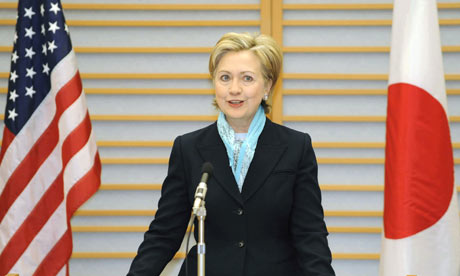
To put this into a little bit of perspective, let me refer you to this article from Al Jazeera that I think accurately shows just how troubling the rhetoric from coming from both sides of the Pacific Ocean is getting. While Hillary Clinton's pledge to defend South Korea and Japan against North Korean aggression sounds at least more sane than Pyongyang's promise of "merciless punishment" for any future Western interference, I can't help but notice how old-fashioned, childish, and ridiculous the whole situation is. It's high time our leaders stop acting like this is an episode of 24 and realize that words having meaning, and there are consequences to thinking that torturing the right people can make up for a lack of insight, sensitivity, and reevaluation of outdated foreign policy.

1. Lack of Moral Standing

The success of nuclear proliferation, disarmament, and the eventual banning of nuclear weaponry altogether relies on, in my opinion, the willingness of influential proponents including the United States to lead by example. Call me idealistic (or perhaps I'm merely being ultra-realist), but Washington has little basis from which to demand a halt to the North Korean nuclear program. The U.S. is the only nation to ever use nuclear weapons, and it chose to do so twice, both times against defenseless civilians. In more recent history, it has failed to repaint its foreign policy image as anything other than troublingly self-interested, while at the same time (perhaps in a related sense) dangerously inconsistent in the when-why-and-how of world policing. Why then are we surprised when countries choose not to take the ever-beneficent U.S. at its word when it says it is working for the well-being and freedom of others? The point being not that the U.S. is evil, but that its history and lack of concrete moral standing causes even its most honest efforts to be held suspect and fall impotent.

Leading by example also involves self-restriction. I whole-heartedly call not only for the end of the North Korean nuclear program, but also that of the United States. Cold War-esque military buildup is no longer a sufficient buffer, and continual armament only serves as provocation and a hindrance to stepping onto the moral high ground. Nuclear disarmament of the U.S. will be the first bold step towards proving to the rest of the world that this nation is a proponent of peace, not mutual destruction.

2. Burning our Bridges

The People's Republic of China is one of the few nations in the world with a semi-open relationship with North Korea. While this relationship is still limited, it is a major mistake to continue burning bridges with China. Tiffs over big business and trade have caused a senseless riff in diplomacy. If the U.S. focused its efforts on bridging these gaps and touching up recent damages in its relationship with China through seeking, among other things, mutual cultural understanding, it will find itself a powerful and much-needed addition to allies in the region.

Embracing a Chinese ally in the North Korea situation would also create a crucial meeting point for important issues such as Taiwanese, Tibetan, and Uighur freedom. Along these lines, another important step towards finding common ground on these as well as the North Korean problem is a recommitment to the terms of the Shanghai communique. There is currently much uncertainty among the Chinese people as to whether or not the U.S. is seeking hegemony abroad. An added bonus to quelling these fears through an end of military aggression and halting our nuclear program would allow again, by means of taking the moral high ground, room to urge China to do the same. While I do not personally fear Chinese aggression outside its own borders, this move would most certainly not hurt.

3. The Sinking Ship

Above I have alluded to the major underlying problem of Washington's current foreign policy which will not cease in sabotaging efforts in North Korea and elsewhere until it is addressed, deconstructed, and revamped. The Obama administration, particularly Secretary Clinton and the President himself, need to realize that this is not World War II, this is not the Cold War, nor is this the Persian Gulf. Sovereign nations do not respond well to threats (empty or serious), nor are they comfortable with the U.S. continuing its role as world police (invited or not). The U.S. would do well in my opinion to take most seriously its role as a member of the United Nations and participant in various international treaties. Treaties have no pull and the UN is powerless as long as its most influential and respected members continuously lecture other nations about adhering to regulations they themselves regularly circumvent.

It seems to me that the New foreign policy of our age, if it is to be effective, should be characterized not by the power-grabbing, aggression, and threats of economic competition but rather by the friendship, understanding, and creativity of cosmopolitan cooperation.

01 April 2009

Brief Thoughts on GM

I've been asked by several people how I feel about Obama and the Federal government essentially telling GM's CEO, Rick Wagoner, to step down from his leadership position at the private company.
First, we should be accurate about how we use the term 'private.' I think the distinction people are trying to make is that it's not a federally owned company. However, GM is not a private company, it is a public company. I only point this out as a pet peeve, and I'm not arguing that that makes them a federal company. I'm simply saying that a publicly traded company is not private. That being said, here's a few thoughts on questions raised over the last few days:
  • Over 15 years ago, GM had the opportunity to place itself on the cutting edge of automobiles with the production of the EV-1. This car consumed zero gallons of gas per mile and had zero emissions. For detailed information about what I'll briefly outline here, watch the great documentary, "Who Killed the Electric Car?". The short story is, a culmination of forces including the oil lobby saw to it that the production of affordable electric cars cease and desist and even ensured that EV-1s already on the road would be reclaimed and promptly destroyed. In place of the Electric Car, GM began production on the Hummer. All this to say that GM dug itself into a deep hole by confining itself to the production of vehicles that were so inefficient and consumed so much fuel, they couldn't even be sold in most foreign markets; nor, as we're seeing now, the U.S. market.
  • As a result of such business practices, GM could no longer keep itself afloat. The leadership turned to the federal government. I am not well-versed enough to know whether the stockholders of the public company were unwilling to support it, or if the company was bent on receiving taxpayer dollars. At any rate, the federal government approved billions of dollars (your dollars) to go towards this failed company. Then, as we all know, the company asked for more money, and got it.
  • For this reason, as much as the federal government deserves to be critiqued on their use of taxpayer money, GM should be critiqued just as sharply, for their willingness to even think about taking tax dollars from the American people directly for themselves completely isolated form any type of service offered, goods sold, etc. If you want to talk about rewarding failure, here's a perfect example.
  • Finally, having received an outlandish amount of funding from the federal government, GM effectively sold their soul. If the federal government and its money are the only thing keeping your company afloat, then Barack Obama can put whoever he wants in charge.
  • As a sort of aside, I would also be interested in hearing whether the company, whose demise or even the thought thereof warrants the absolutely insane type of bailout we've seen (the defense of which rests on the fact that if the company collapses, our entire economy will collapse), is in fact already nationalized.
Thoughts?

28 March 2009

The Conservatives' Big Lie + How it Won Obama the Presidency + The Truth

Villagers protest drone bombings authorized by President Obama which have murdered donzens of civilians.

“Barack Obama wants to wave the white flag in the war on terror.” I think most people can remember hearing similar statements during the exceedingly long presidential campaign. Some people might even remember believing it after having it drilled into their heads for so many weeks by GOP politicians, conservative pundits, and right-wing talk radio. The intense onslaught of spin and propaganda was intended to “wake up America,” “expose the radicals,” and in short, damage Obama in order to keep a Republican in the White House.


However, I regret to inform Rush Limbaugh and the lot that the effort to paint Obama as a European-style peacenik (an image Obama was happy to accept) is precisely what handed the election over to him. It is a dying shame that the overwhelming effort to make this big lie into a publicly recognized truth put the Stop Obama Express on a countdown to self-destruction.


The irony is that, rather than inflame the conservative base enough to drown out or reeducate the left, the lie actually ignited overwhelming numbers of young liberals. Once the idea of Obama as a candidate for peace began to be perceived as true, the GOP could kiss their presidential hopes goodbye, as that is exactly the type of candidate so many in our generation want. Even outside left-leaning student circles, America was ready for change, ready to leave the ways of militaristic power struggles behind; and conservatives showed them exactly who to vote for. The only problem was that many of these Obama voters did not have the wherewithal or desire to do the research necessary to find out they were being duped.


One needed only listen to what President Obama expressly stated in any number of nationally televised debates during the primaries to know that, far from waving the white flag in the war on terror, he would keep the nuclear option on the table in relation to Iran, raise troop levels in Afghanistan, carry out military operations across Pakistani borders without their permission, and continue anti-terrorism aggression in Iraq. For what it’s worth, Obama was at least honest, since he has followed through on all of the above.


Just this week, President Obama reminded the American people that they should be scared; al-Qaeda is “actively planning” attacks on the U.S. from Pakistan! He then had the gall to ask Congress for over a billion dollars to fund a military solution to the problem and mask it as a favor to the people of Pakistan. He also stated that we will "defeat terrorism," yet refrained from defining either what terrorism is, or exactly how many people need to be killed in order for it to be defeated. I hope I’m not the only one having some major déjà vu right about now:

"The regime has longstanding and continuing ties to terrorist groups, and there are Al Qaida terrorists inside Iraq." - George W. Bush (9/28/2002)

"If we're successful in Iraq, if we can stand up a good representative government in Iraq, that secures the region so that it never again becomes a threat to its neighbors or to the United States, so it's not pursuing weapons of mass destruction, so that it's not a safe haven for terrorists, now we will have struck a major blow right at the heart of the base, if you will, the geographic base of the terrorists who have had us under assault now for many years, but most especially on 9/11." - Dick Cheney (9/14/2003)

If Conservatives wanted to win the election, they need only have pointed out the bare naked truth about Obama’s militaristic tendencies and refusal to Imagine a United States that can hold itself together without a war. Loyalty would have then been fragmented away to third party candidates who offered a platform of peace, and John McCain would have won the election.


Bearing this in mind, for the time being, maybe we should count our blessings.


18 March 2009

Rejecting Obama Bush-era Policy

Amidst the Hope expressed in the impending closure of Guantanamo bay and the official rejection of torture as a legitimate interrogation technique, we cannot help but feel short-changed by the White House as our watchful eyes make us painfully aware of what these symbolic—nevertheless important—acts are intended to mask.

Beneath the façade of Change and progressive foreign policy, lies a disturbing cache of stockpiled Bush-era stratagem ranging from extraordinary rendition to preemptive war, combined with the same destructive ego/natio-centric worldview which takes great pains to justify every sort of evil by way of self-interest and self-preservation.

As civilian casualty rates in Afghanistan reach an all-time high and the documented number of such deaths in Iraq approaches the 100,000 mark, we are compelled to reflect on the high price paid for our national security. We are compelled to beg of President Obama an answer to the question first posed by Mahatma Gandhi, “What difference does it make to the dead, the orphans and the homeless, whether the mad destruction is wrought under the name of totalitarianism or the holy name of liberty or democracy?”

We can no longer bask in our own privileged circumstance, averting our eyes from those unfortunate enough to live on the wrong side of the world; the side where a family is just as likely to be blown to pieces by a suicide bomber as they are to be incinerated inside their own home by a Coalition missile.

Despite the wave of popularity surrounding the new President, and the dizzying array of inane economic noise, we, the American public, refuse to be seduced or distracted. We challenge our new national leaders to publicly defend the policies they reject in their rhetoric, yet retain behind closed doors. We will not stand idly by, smiling to ourselves as 17,000 more U.S. armed forces are sent into Afghanistan to kill or be killed in service of the nation, its market, its consumerist ideals, and its political interests.

Let us remember that, “To fight violence with violence can only ever result in a victory for violence, not a victory over it,” as Bishop N.T. Wright warns.

It is high time the American people, particularly Christians, call into question the appropriateness of Obama’s decision to continue drone bombings in the sovereign nation of Pakistan, which invariably result in the murder of innocent families.

We, the Church, must openly reject the destroy-them-before-they-destroy-us mentality which President Obama has allowed to carry over into this new administration, as all resulting policy is in no way life-giving, redemptive, or reflective of faithful human be-ing. This mentality, being in every way inappropriate for any type of Christian or civil interaction, can no longer be seen as legitimate policy, blindly accepted, or passively coalesced.

20 December 2008

So, What About 9/11: The Cost of National Security (If it Exists)


Addressing the U.S. Army War College on December 17, the outgoing President Bush delivered a direct and extended final defense of his administration’s foreign policy over the last 8 years. While the speech covered a range of topics, a key point was the President’s adamant reminder that because of his post-9/11 policies, there has not been a major terrorist attack on U.S. soil. It is this point, which enjoys frequent play from conservative mouthpieces and White House spokespeople alike, that I wish to examine along several lines which I believe beg acknowledgment and harsh critique.

1. “So, What About 9/11?”

Even more puzzling than the attempt to take credit for the nation’s post-9/11 safety without ever admitting the failure to keep the nation safe on that particular day, is the herd-like sheepishness of those who accept such desperate school playground tactics. It is not my intent to open a 9-11-truth discussion; at this point I do not believe that the U.S. had a hand in planning or purposefully allowing the attacks. My point is simply that the hard line Bush is trying to draw between pre and post is faulty. There indeed have been no terrorist attacks on U.S. soil since 2001. However, if he desires any praise to rest on his shoulders for the policies which have kept the homeland safe, he MUST also accept responsibility for the policies which failed to protect us on 9/11. To my knowledge there has been no formal apology to the families of those who lost their lives, or to the nation. Rather, the events of that day have been exploited in ways that need no extended description here. Let it suffice to point out that for the majority of Americans since the founding of the nation, a basic role of government is to protect its citizens from foreign powers who wish them ill. Having failed in that role on 9/11, this administration has sought to (perhaps successfully) redefine the way its citizens conceive of protection. Rather than protection meaning a kind of preventative measure to ensure safety, people are now content to observe vicarious vengeance and disproportionate aggression in a volume sufficient to drown out the pain of having not been protected, and provide a false (yet sufficient) sense of security amid fear of not being safe. Incidentally and circularly, this fear is what allows said government to continue carrying out its failed policies.

To reiterate, ultimate responsibility for the thousands of murders which took place in the terrorist attack lies on those who carried them out. That being said, we and the President must at least be consistent in our giving and receiving of praise. If Bush is responsible for successful policies, as President of the United States, he must also accept responsibility for the failed ones.

2. “How We Got Safe.” and “Are We Really?”

‘Torture’ is the word of the day here, and for Vice President Cheney, it’s almost as easy to redefine as ‘protection’ or maybe ‘executive branch.’ In order to even discuss this topic rationally, we must put behind us what seems to be, based on back-and-forth contradictory statements the White House has made over the last 8 years, the Bush administration’s anti-rational confusion about what exactly torture is, whether or not they use it, and whether or not it is immoral. Let’s simply pick up with their most recent story—they do use it, and that’s okay because there hasn’t been a single terrorist attack on U.S. soil since 9/11. Amid CRIMINAL investigations into the U.S. government’s use of torture in the war on terror, Cheney cited, in so many words, his clear conscience on the matter because of the legal advice the White House sought regarding the use of torture and how to not call it torture anymore.

What this all comes down to then, is that torture, which has, since the dark ages, until recent years been universally frowned upon as inherently evil, is now being presented as not-so-bad if it keeps the people perpetrating it safe and is okay with their lawyers. I will expand on just how torture is NOT okay in section 3.

It may be relevant to address the question of whether torture has indeed made us safer, despite the inconsequentiality of the answer next to the prime question of its morality or lack thereof. The Bush administration has been clear and consistent in asserting that it is indeed effective and, in case you’ve forgotten, has on various occasions saved us from terrorist attacks on U.S. soil. However, this is in direct conflict with the unanimous conclusion of counterterrorism officials and experts (besides Bush, Cheney, Rice, Rumsfeld, etc.) in the U.S. and around the world who know that “not only have coercive methods failed to generate significant and actionable intelligence, they have also caused the squandering of resources on a massive scale through false leads, chimerical plots, and unnecessary safety alerts.” The facts of the matter are simple: A tortured person who knows nothing will at some point tell the torturer whatever it is that he or she wants to hear, while by and large, a dedicated individual who does have information, will never give up sensitive details essential to the success of his or her cause (take for instance, John McCain).

To conclude this section, let us recall that according to the Bush administration, the safety of our homeland is thanks in large part to the implementation of the medieval-Spanish Inquisition-barbarian-style practice of torture. God bless the USA and God bless the desecration of human dignity. (I’ll leave it up to you to decide whether it is the dignity of the torturer or the tortured being desecrated.)

3. “At what cost?”

Another striking aspect of the gloating declaration of the safety of our homeland since 9/11 is its blatant ego- and ethno-centrism. Are we Americans to smile and accept this ‘safety’ without reflecting on the murders of hundreds of thousands of people who are unfortunate enough to live in Iraq, Israel, Afghanistan, Pakistan, or other countries who endure DAILY terrorist attacks? Some of which, specifically in Iraq, are in response to the presence of U.S. military forces. Furthermore, are we to ignore the thousands of murders which have directly resulted during military and counter-terrorism operations, basking in our own privileged circumstance of not living down the block from a terrorist? Though I won’t expand on this here, if one were to do so, the President’s statement at the Army War College, “We expanded our efforts to combat the conditions of despair and hopelessness that give rise to rage and radicalism,” is more ironic than true. Again, to my knowledge, there has been no formal apology from the White House to the families of the innocent civilians killed in the War on Terror, and until there is, the President cannot expect to receive any praise for the ousting of Sadaam Hussein and the Taliban.

Similarly, when we return to the subject of torture, we must ask ourselves what the cost of our ‘safety’ really is. Now that torture has been implemented and defended as a legitimate policy, the U.S. government has placed itself in the company of many less-than-savory historical and contemporary characters, and listing any will no doubt invite angry responses from readers; but, I think we can all think of a few. Like such villains, it is hard to imagine how history—in a manner Bush is banking on—could smile on such tactics, those who carried them out, or those who endorsed and defended them.

The final cost I want to open for discussion, rather than draw out here, is theological in nature. Christians universally affirm that all human beings are created in the image of God, and I believe it is necessary, especially for Evangelicals who so readily tow the neoconservative line, to reflect on how the use of torture and pre-emptive aggression relates to our view of this image-bearing. James tells us that faith is dead if we simply claim it without putting it into practice. Relating back to other topics I’ve mentioned, are we justified in viewing people who bear the image of God as collateral damage in a desperate attempt to save our own nation, our own hyper-consumerist economy, or our own political interests? And how are we to derive from Scripture a kind of guideline as to when a person ceases to bear the image of God, or what types of behavior or situations grant us the right to treat them as if they do not? Finally, when we torture another human being or intentionally kill an innocent human being in order to get the bad guys, in what way are we fulfilling our own roles as image-bearers? Christ tells us in Mark 12:17 that we who bear the image of God belong to Him and are to go about the work of HIS Kingdom, not Caesar's.

Policies of pre-emptive aggression and torture, while touted by many as having kept our nation safe, must be sharply criticized and no longer blindly and passively accepted as effective and morally right. Furthermore, these policies must be questioned as to how they reflect or do not reflect the events of 9/11 which have since been exploited to justify them. For Christians and non-Christians alike, the Bush mentality of destroy-them-before-they-destroy-us is directly reflective not of the good life enjoyed in the Kingdom of God, nor the civility of human-being, but the violent, sociopathic behavior of the prison yard.


25 October 2008

The Presidential Dichotomy (10/16/08)

before adding my thoughts, i wanted to share a section of an article written by james k.a. smith (some of you are familiar with him) that i came across on his website.

the article addresses several issues that i think will present us with some interesting and beneficial points of discussion. at the very least, some of you will decide to be offended, which if nothing else will make things lively.

Ronald Reagan was no intellectual, but he had an earnest faith in ideas and he spent decades working through them. He was rooted in the Midwest, but he also loved Hollywood. And for a time, it seemed the Republican Party would be a broad coalition — small-town values with coastal reach.

In 1976, in a close election, Gerald Ford won the entire West Coast along with northeastern states like New Jersey, Connecticut, Vermont and Maine. In 1984, Reagan won every state but Minnesota.

But over the past few decades, the Republican Party has driven away people who live in cities, in highly educated regions and on the coasts. This expulsion has had many causes. But the big one is this: Republican political tacticians decided to mobilize their coalition with a form of social class warfare. Democrats kept nominating coastal pointy-heads like Michael Dukakis so Republicans attacked coastal pointy-heads.

Over the past 15 years, the same argument has been heard from a thousand politicians and a hundred television and talk-radio jocks. The nation is divided between the wholesome Joe Sixpacks in the heartland and the oversophisticated, overeducated, oversecularized denizens of the coasts.

What had been a disdain for liberal intellectuals slipped into a disdain for the educated class as a whole. The liberals had coastal condescension, so the conservatives developed their own anti-elitism, with mirror-image categories and mirror-image resentments, but with the same corrosive effect.

The federal electoral game has come down to a tribalism. The presidential debates have amounted to little more than another opportunity for the candidates to preach to their respective choirs. And thus campaigns come down to little more than a bet on who has the bigger choir, and who can motivate their choir to come out and vote. Since the elite choir that the Republican party really serves is so small, they had to look for a cagey way to find another choir. Their bet--embodied in Palin--is that there is a massive, perhaps largely quiet, choir composed of Joe Sixpacks in the middle of the country--a choir whose anthem is a long disdain for complexity and "learning."

But that's not "conservatism." It is a wanton disdain for the wisdom of the past that has spiraled into a reverie of ignorance cloaked as "common sense." That such people get a vote is exactly why conservatism has always had an uneasy relationship with democracy.


i don't think anyone from any edge of the political spectrum will deny after some reflection that the dichotomy smith observes as developing over the last few decades between the anti-elitism of the right and the condescension of the left, has manifested itself in the current nominees for president and vice president from the two dominant parties, or at least in the way their campaigns have operated.

consider the rejected candidacy of dr. ron paul. i would argue, and i think many would agree that no candidate from either party is more qualified to address the current economic crisis of this country. furthermore, in my opinion, ron paul was the ONLY republican candidate with a sane foreign policy. obviously, i can't prove this by any means, but i wonder how many people chose not to vote for him because of the way he spoke (that is to say, his vernacular was that of a college professor rather than a big game hunter) and the fact that he was interested in engaging in legitimate, intelligent political debate about relevant issues, rather than stirring people up with one-line zingers or cheap appeals to patriotism, anger or fear.

understandably, what the GOP has come up with are two candidates who either are, or present themselves as, the opposite of intellectual. an example would be in tonight's debate, mccain criticized obama, who, after presenting his energy plan which he claimed would aggressively pursue alternative energy and push oil companies to drill on the thousands of acres of land they already own but have yet to make use of, said he would also think about off-shore drilling. mccain chuckled and emphasized obama's use of the word, 'think.' off-shore drilling, he insisted, must be started immediately; considering one's options, reflecting on the possible consequences of one's actions, etc—that's pointy-headed east-coast mumbo jumbo!

it cannot be ignored that mccain's critique here is indicative of a hyper-consumerist worldview which demands immediate (and necessarily temporary) satiation of one's most immediate desires (which are perceived as needs).

then we have sarah palin, who makes barack obama look over-qualified. what at first to me seemed a very curious choice for a running mate, is now making more and more sense. she is the complete opposite of an academic, for one thing. she stays away from the big words ron paul used, as well as the big issues he addressed. while she accurately reminds us that she didn't come out of washington and is just like all the joe (and jane) plumbers out there, she brings nothing new, innovative, or interesting to the political table; she totes the neo-conservative line and is sure to throw in a few smackeroos in her speeches. while i would thus not be inclined to vote for jane plumber, that, my friends (as mccain would say), is more than enough to scoop up the votes john has been after since 2000.

of course, i can't go without addressing my problems with the other side of the aisle, but i'll save that for another time.

thoughts?